Microsoft and Saudi Arabia’s HUMAIN have announced a long-term strategic collaboration aimed at moving Arabic-language AI from experimentation into large-scale enterprise deployment. The partnership, announced on August 26, 2026, starts with plans to bring HUMAIN’s ALLAM models into Microsoft’s AI ecosystem and pair HUMAIN’s AI experts with Microsoft’s Forward Deployed Engineers.
The announcement is notable because it combines three themes attracting major investment across the Middle East: sovereign AI, Arabic-language models and enterprise deployment. Instead of focusing only on a model launch, the companies are emphasizing how AI can be integrated into everyday business workflows and production systems.
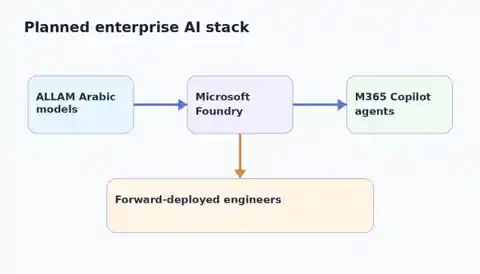
Why this matters: The companies intend to make ALLAM available through Microsoft Foundry and connect its Arabic capabilities to the Microsoft 365 Copilot ecosystem, potentially giving enterprises a more locally relevant foundation for Arabic AI applications and agents.
ALLAM Is Planned for Microsoft Foundry
Microsoft and HUMAIN say they intend to make ALLAM available through Microsoft Foundry. That would give developers and enterprises access to HUMAIN’s Arabic-language models inside Microsoft’s broader AI platform.
The idea is to let organizations build, customize and deploy applications and agents that better reflect Arabic language and regional business requirements. For companies operating across Saudi Arabia and the wider Middle East, this kind of local-language capability can be important when general-purpose global models do not fully capture dialect, context or organization-specific terminology.
Microsoft 365 Copilot Could Be Another Entry Point
The partnership also includes plans to bring ALLAM capabilities into the Microsoft 365 Copilot ecosystem. According to the companies, organizations could create specialized agents that use ALLAM’s Arabic-language capabilities inside productivity and business workflows.
That is important because enterprise AI adoption is increasingly being driven by existing software surfaces. A company is more likely to use AI at scale when it appears inside the tools employees already use for documents, communication, analysis and collaboration.
Instead of asking workers to adopt a completely new AI application, Microsoft can potentially expose locally relevant models through familiar enterprise products.
Forward-Deployed Engineers Are a Big Part of the Strategy
One of the most practical parts of the announcement is the emphasis on Forward Deployed Engineers, or FDEs. HUMAIN’s AI experts and Microsoft’s engineering teams are expected to work directly with organizations to identify high-value use cases, integrate AI into existing systems and support the transition from pilot projects into production.
This addresses one of the biggest gaps in enterprise AI: having access to a capable model does not automatically create business value. Organizations still need to decide which workflows are worth changing, how systems should connect, how data should be governed and how deployments should be monitored.
Hands-on engineering can be the difference between a flashy proof of concept and an AI system that actually runs inside a company.
Why Arabic-Language AI Is a Large Opportunity
Arabic is spoken by hundreds of millions of people, yet many of the world’s most popular generative AI systems were initially optimized around English-heavy datasets and workflows. Models designed with stronger Arabic language and cultural context can therefore address a meaningful gap.
ALLAM represents HUMAIN’s effort to build AI that is more relevant to Arabic users and organizations. Microsoft’s distribution and enterprise platforms could significantly expand where those capabilities are used.
The opportunity is not limited to chatbots. Arabic-language AI can be applied to document processing, customer service, government services, internal knowledge systems, productivity agents, analytics and industry-specific workflows.
Saudi Arabia Is Pushing From AI Ambition to AI at Scale
The collaboration fits into Saudi Arabia’s broader effort to build local AI capacity as part of its technology and economic transformation. Microsoft has previously highlighted the Kingdom’s investment in cloud infrastructure, skills and responsible AI deployment.
HUMAIN, a Public Investment Fund company, is positioned as a full-stack AI player covering models, applications and infrastructure. Partnering with Microsoft gives it a route into one of the world’s largest enterprise software ecosystems.
The infrastructure side is also becoming increasingly important. As AI models and agents move into production, organizations need more compute, networking and data-center capacity. That trend is visible globally, including in NVIDIA’s latest surge in AI data-center revenue.
Microsoft HUMAIN ALLAM in the Wider Agent Race
The partnership also fits the broader shift from standalone chatbots toward agents that can operate inside business systems. Our guide to AI agents becoming digital coworkers explains why governance, permissions and human approval become more important as AI gains access to enterprise tools. For a wider snapshot of current models, agents and infrastructure, see our biggest AI news overview.
The Partnership Is Designed to Expand Beyond ALLAM
Microsoft and HUMAIN describe ALLAM as the first technology milestone in a broader relationship. The companies say they plan to explore deeper collaboration across productivity, devices, models, infrastructure and joint go-to-market initiatives.
That means the current announcement should be seen as a starting point rather than a final product roadmap. The first phase is centered on Arabic models and deployment support, but the longer-term collaboration could touch more of the AI stack.
Why Enterprise AI Is Becoming More Local
One of the most important trends in AI is the growth of region-specific and sovereign models. Governments and enterprises increasingly want AI systems that fit local languages, regulations, security requirements and data-governance expectations.
Global foundation models remain extremely powerful, but local models can add value when organizations need stronger cultural context or specific language performance. Partnerships between local AI companies and global cloud platforms may become a common way to combine both approaches.
What Businesses Should Watch
The next questions are practical. Enterprises will want to know when ALLAM becomes broadly available in Microsoft Foundry, how pricing and licensing work, what deployment options exist and how the model performs on real business tasks compared with global alternatives.
Organizations will also be watching governance. As specialized agents become part of mission-critical workflows, security, auditability, permissions and human oversight will matter as much as model quality.
FAQ
What is the Microsoft–HUMAIN partnership?
It is a long-term strategic collaboration focused initially on bringing HUMAIN’s ALLAM Arabic-language models into Microsoft’s AI ecosystem and providing hands-on engineering support for enterprise AI deployments.
Where will ALLAM be available?
The companies say they intend to make ALLAM available through Microsoft Foundry and connect its capabilities to the Microsoft 365 Copilot ecosystem.
What are Forward Deployed Engineers?
They are engineers who work directly with customers to identify use cases, integrate systems and help move AI projects from experimentation into production.
Is the partnership limited to Saudi Arabia?
The announcement focuses on Saudi Arabia but describes ambitions extending to the broader Middle East, Africa and other markets over time.
Bottom Line
Microsoft and HUMAIN are betting that the next stage of enterprise AI in the region will require more than access to powerful models. It will require Arabic-language capability, enterprise software integration, local context and engineering teams that can turn AI into working systems.
If ALLAM gains meaningful distribution through Microsoft Foundry and Copilot, the collaboration could become an important test of how regional AI models scale through global platforms.