OpenAI and AWS are deepening their push into AI-native software development with a new integration that brings the full GPT‑5.6 family — Sol, Terra and Luna — into Kiro, Amazon’s software development agent. The announcement, published August 24, 2026, is designed around a simple promise: give developers more model choice while improving the amount of useful engineering work they get from every dollar spent.
The integration matters because AI coding is moving beyond autocomplete. The new generation of developer tools is increasingly expected to understand requirements, reason across a codebase, plan implementation steps, review its own work and validate results before changes ship.
The headline number: OpenAI says testing on Terminal-Bench 2.1 found that GPT‑5.6 Terra completed successful tasks in Kiro at roughly 82% lower cost. That result applies to the tested Kiro environment and successful benchmark tasks, not every coding workflow everywhere.
GPT‑5.6 Sol, Terra and Luna Are Now in Kiro
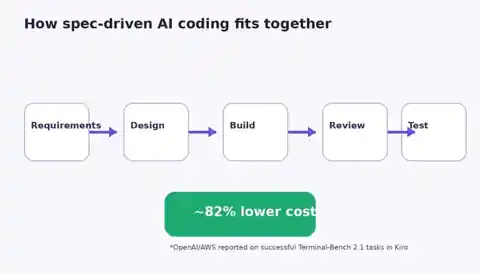
OpenAI says the GPT‑5.6 model family is now available inside Kiro for workflows where teams plan, build, review and test software. The three models provide different options around intelligence, speed and cost, allowing developers to match the model to the stage of the software lifecycle.
The broader value proposition is not simply access to a new model dropdown. OpenAI says GPT‑5.6 has been optimized around better performance per dollar and more useful work per token, while Kiro contributes a structured development environment that gives the model clearer context.
Why Spec-Driven Development Is Central to the Announcement
Kiro is built around what it calls spec-driven development. Instead of asking an AI model to jump directly from a short prompt to code, the workflow can turn product ideas into clearer requirements, technical designs and executable implementation tasks.
That structure is important for larger engineering jobs. A model that understands the intended behavior of a system, the surrounding codebase and team standards has a better chance of producing work that fits the project instead of generating isolated code snippets.
OpenAI says developers can use GPT‑5.6 in Kiro to:
- Turn product requirements into structured implementation plans.
- Complete complex, multi-step coding work with more consistency.
- Use context from a repository and established team standards.
- Review and refine AI-generated work at defined checkpoints.
- Check correctness with property-based testing.
The 82% Cost Reduction Needs the Right Context
The number most likely to attract attention is the reported 82% cost reduction. OpenAI says that after joint optimization work with AWS, GPT‑5.6 Terra completed successful Terminal-Bench 2.1 tasks in Kiro at roughly 82% lower cost.
That is an impressive figure, but it is important to interpret it carefully. It does not mean every developer will suddenly pay 82% less for every coding task. The benchmark result reflects a specific model, environment and set of successful benchmark tasks. Real-world savings will depend on repository size, task complexity, number of retries, tool use, context length and the amount of human review required.
Still, the direction of travel is important. AI coding economics are increasingly being judged by cost per solved task, not just token price. A model that uses more expensive tokens but reaches the correct result in fewer attempts can ultimately be cheaper than a model with lower headline pricing.
AI Coding Is Becoming an Engineering System, Not a Chat Box
Early AI coding assistants often felt like enhanced autocomplete. The new agentic tools are being designed more like engineering systems. They can read broader project context, create plans, coordinate multi-step changes and pause for human review before implementation.
That shift matters for businesses deciding how much authority to give AI inside production codebases. Reliability, auditability and predictable checkpoints become more important as the model moves from suggesting a function to modifying a complex application.
Kiro’s structured workflow is clearly meant to address that concern. Requirements and technical designs create a paper trail around what the agent is trying to do, while review steps can help keep humans involved before important changes are applied.
Why the OpenAI–AWS Partnership Matters
OpenAI and AWS say they worked together to optimize both the Kiro environment and the OpenAI models. The partnership is notable because the competition around AI coding tools is no longer just a model race. It is also a race between integrated development environments, cloud platforms, agent frameworks and model providers.
AWS wants Kiro to become a serious home for long-running agentic development tasks, while OpenAI wants GPT‑5.6 to be available where developers already work. The combination puts them into closer competition with other AI coding platforms and integrated assistants.
The timing is also significant. The broader AI infrastructure market is still expanding quickly, as shown by NVIDIA’s latest data-center results. As compute becomes more available, the next question is how efficiently software tools turn that compute into finished work.
GPT-5.6 Kiro in the Wider Agent Race
Kiro’s spec-driven workflow is another example of AI moving from isolated suggestions toward delegated, multi-step execution. Our guide to AI agents becoming digital coworkers looks at the governance and approval questions that come with that change. You can also see how Kiro fits alongside recent model, hardware and agent releases in our biggest AI news overview.
What Developers Should Watch Next
The most useful follow-up data would be broader real-world comparisons across repositories, programming languages and different kinds of engineering tasks. Teams will want to know not only how often an agent succeeds, but also how many retries it needs, how much human review time is required and whether changes introduce regressions.
Cost per successful task is a more meaningful metric than raw token pricing, but only when the definition of “successful” reflects what development teams actually care about.
FAQ
Which GPT‑5.6 models are available in Kiro?
OpenAI says the GPT‑5.6 family in Kiro includes Sol, Terra and Luna.
What is Kiro?
Kiro is an AI-native software development agent from AWS designed around structured, spec-driven workflows for planning, implementation, review and testing.
Did OpenAI really report an 82% cost reduction?
Yes, but the claim is specific: OpenAI says GPT‑5.6 Terra completed successful Terminal-Bench 2.1 tasks in Kiro at roughly 82% lower cost after optimization work with AWS. It should not be generalized to every software task.
Is GPT‑5.6 available in Kiro now?
OpenAI says the GPT‑5.6 family is available in Kiro.
Bottom Line
The GPT‑5.6–Kiro integration is a strong example of where AI coding is heading: structured context, multi-step execution, human checkpoints and an increasing focus on cost per completed task.
The 82% benchmark figure will get the clicks, but the deeper story is more important. Model quality alone is no longer the whole product. The development environment, context management, review process and testing harness can materially change both reliability and economics.